Tel
+86 189 2488 5105

Global public seating service provider
Foshan Winner Furniture Co., Ltd.
Tel
+86 189 2488 5105
Businesses increasingly need meeting rooms that support board meetings, training sessions, workshops, presentations, and events without assigning a separate room to every activity. I find that Folding Conference Room Chairs for Space Efficient Meeting Areas are useful because they combine movable seating with compact storage and quick room changes. Instead of leaving a fixed chair layout in place, staff can fold, transport, and redeploy the chairs according to the next activity.
Folding conference room chairs are seats with a hinged frame or seat-back mechanism that allows the chair to collapse into a smaller storage profile. Their main benefits are compact storage, rapid room reconfiguration, portability, and suitability for multipurpose meeting areas. Folding designs reduce depth when stored, stacking designs build vertically, and nesting designs overlap horizontally or diagonally. The right choice depends on setup frequency, storage access, staff handling, comfort requirements, and purchasing budget.
Folding conference room chairs reduce stored depth and support faster changes between boardroom, classroom, theater, and event layouts.
A 12-by-16-inch writing tablet can support note-taking without adding a separate table to every seat.
Commercial models may combine reinforced steel frames, ergonomic backs, padded seats, and stated 300-pound weight capacities.
Folding, stacking, and nesting chairs differ mainly in mobility, storage footprint, handling effort, and room-change frequency.
A practical purchase decision should include chair price, freight, storage carts, maintenance, warranty terms, and replacement costs.
Folding conference room chairs are portable meeting seats designed to close or fold when they are not in use. Most models use a metal frame, molded or upholstered seat, back support, and a hinge or folding joint. Some include writing tablets, linking devices, book racks, armrests, or casters for training and event applications.
I normally separate these chairs into three functional groups. Traditional folding chairs collapse into a thin profile for storage, folding training chairs may include a writing surface, and mobile folding chairs can include casters or transport features. A model designed for a two-hour board meeting may not be suitable for a six-hour training session unless the seat padding, back support, and posture support are adequate.
A folding chair improves space use in two ways: it reduces the occupied floor area when stored and allows the same room to support several layouts. For example, a 12-by-20-foot room can be arranged with a central conference table during management meetings, then changed to two classroom rows or a theater layout after the table is removed. The chair mechanism does not create additional square footage, but it reduces the furniture that must remain on the floor.
For preliminary planning, I use the following storage estimates rather than relying only on product photographs. Exact dimensions vary by model, upholstery, arms, writing tablets, and cart design, so buyers should confirm the folded width and stack height before ordering.
| Storage method | Typical stored footprint per chair | Approximate vertical capacity | Best operational use |
|---|---|---|---|
| Folding chair on cart | 5–9 inches deep | 10–20 chairs per cart section | Frequent room changes and transport |
| Stackable conference chair | 8–12 inches deep | 4–12 chairs per stack | Permanent or semi-permanent storage |
| Nesting chair | 7–11 inches deep when nested | 8–20 chairs per group | Fast horizontal movement and clean storage |
| Folding chair with tablet | 8–14 inches deep | 6–15 chairs, depending on tablet design | Training, seminars, and workshops |
A 100-square-foot storage zone may therefore hold about 20 to 40 folded or stacked chairs, depending on carts, aisle clearance, armrests, and fire-safety requirements. I recommend reserving at least 30 inches of accessible passage around the storage area and leaving enough turning space for the cart. The final capacity should be calculated from the manufacturer’s folded dimensions rather than the nominal seat width.
Folding chairs work best as part of a wider space-saving office furniture plan for meeting rooms. Folding or flip-top tables can be moved against a wall, mobile whiteboards can separate work groups, and compact storage carts can keep chairs close to the room without blocking exits. This modular approach supports a room that changes function during the day.
For a small business or coworking space, I would prioritize a consistent chair width, a manageable cart weight, and a storage location within one short route of the meeting room. For a SaaS office or startup with frequent all-hands meetings, chairs with writing tablets may reduce the need for additional training tables. For executive meetings, upholstered backs and neutral finishes may matter more than the smallest possible storage profile.
The difference between folding and stackable conference room chairs is mainly the storage action. A folding chair closes through a hinge, while a stackable chair remains rigid and is placed vertically on top of another chair. A nesting chair slides into the next chair, creating a connected row or compact group without requiring the chairs to be lifted as high.
| Decision factor | Folding | Stacking | Nesting |
|---|---|---|---|
| Setup frequency | High | Low to medium | Medium to high |
| Storage access | Very good with carts | Good when stacks are stable | Good for grouped movement |
| Lifting effort | Low when cart-mounted | Higher as stack height increases | Moderate |
| Floor footprint | Usually smallest when folded | Efficient vertically | Efficient horizontally |
| Mobility | Strong with a cart or casters | Moderate | Strong when designed with wheels |
| Budget position | Low to medium | Low to medium | Medium |
| Best setting | Training, events, multipurpose rooms | Fixed meeting rooms | Flexible offices and conference centers |
I choose folding designs when staff must change the room several times each week or when chairs need to pass through narrow storage doors. I choose stacking chairs when the room has a dedicated storage wall and the arrangement changes only occasionally. I choose nesting chairs when staff need to move grouped chairs quickly while keeping the rows visually organized.
Comfort depends on more than the presence of padding. I examine seat depth, seat height, back curvature, lumbar support, front-edge pressure, arm clearance, and the amount of time users will remain seated. For meetings longer than two hours, a shaped back, breathable material, and a waterfall-style seat edge can reduce pressure behind the knees.
Commercial specifications should also be checked carefully. WINNER Furniture describes reinforced steel frames, double-welded joints, commercial-grade finishes, optional mesh backs, padded seats, ergonomic contours, and a stated 300-pound capacity on selected training-chair products. Some training models also list a 12-by-16-inch writing tablet, which is useful when participants need laptops, forms, or notebooks without a separate desk.
For inclusive seating, I recommend providing several chairs without arms, a few wider or higher-capacity options, and clear access routes for users with mobility devices. Avoid placing every chair tightly against a table because reduced knee clearance can make the room difficult to use. The final layout should preserve clear circulation, accessible seating positions, and stable surfaces for writing or laptop use.
A folding mechanism creates moving points that require more inspection than a fixed four-leg chair. Before purchase, I check hinge guards, fasteners, frame welds, locking points, foot glides, and the possibility of finger pinch points during opening and closing. Staff should receive a short handling procedure that keeps hands away from hinges and prevents chairs from being dropped onto the floor.
A useful commercial benchmark is a published 200,000 sit-cycle test for selected training-chair designs, but buyers should confirm which exact model was tested and under what conditions. I also check the rated load, frame material, finish, upholstery cleaning instructions, replacement parts, and whether the chair remains stable on carpet and hard flooring. Floor glides should be compatible with the surface so repeated movement does not create scratches or excessive noise.
Cleaning requirements should match the room’s usage. Fabric seats may need vacuuming and approved upholstery cleaning, while polypropylene or coated surfaces can usually support faster wipe-down procedures. For high-turnover training rooms, I prefer replaceable glides, accessible fasteners, and upholstery colors that make routine marks visible without making every minor stain prominent.
Folding chair storage carts for offices can reduce manual lifting, shorten setup time, and keep folded chairs aligned. I recommend a cart with a stated load limit, protective contact points, non-marking casters, a handle height suitable for the staff, and a footprint that fits through the storage door. If the cart holds 20 chairs, the storage area must accommodate both the cart and a safe turning path.
Carts should not be parked in front of fire exits, electrical panels, emergency equipment, or accessible routes. When chairs have writing tablets, arms, or attached baskets, the cart must be designed for that specific configuration rather than a basic armless chair. I also suggest labeling carts by room, chair type, and maximum capacity so staff do not overload them or mix incompatible models.
The following table is a planning comparison rather than a formal quotation. Commercial pricing changes with quantity, upholstery, tablet options, export packaging, freight, duties, and installation, so I would request a written quote before approving a purchase. Lead times and warranties should also be confirmed in the sales contract because they may differ between standard stock and customized OEM or ODM orders.
| Supplier route | Typical planning price per chair | Indicative lead time | Warranty and service point | Best fit |
|---|---|---|---|---|
| WINNER Furniture OEM/ODM folding or training chair | US$45–US$160 before freight and duties | About 30–60 days for standard or customized orders | Request written term, exclusions, spare-part policy, and testing documentation | Bulk projects, training rooms, conference facilities |
| U.S. commercial furniture dealer | US$110–US$350 | About 2–10 weeks, depending on inventory | Often dealer-processed manufacturer warranty | Offices needing local delivery and service |
| Contract seating manufacturer through bid | US$180–US$500 | About 8–16 weeks for larger projects | Written commercial warranty is usually part of the bid package | Government, education, and high-volume facilities |
| Local reseller or refurbished supplier | US$35–US$180 | About 1–4 weeks when inventory exists | Warranty may be limited or seller-specific | Budget-sensitive rooms and short-term expansion |
WINNER Furniture identifies Foshan Winner Furniture Co., Ltd. as its operating company and presents folding chairs, training chairs, chairs with writing tablets, mobile models, and custom configurations for conference and training environments. Its product information includes reinforced frames, commercial finishes, mesh or padded backs, optional writing surfaces, and models with wheels. I would still request exact folded dimensions, carton dimensions, load rating, test reports, warranty coverage, and production schedule for the selected chair.
Total cost of ownership is more useful than unit price alone. A budget calculation should include chairs, carts, freight, customs, installation, replacement glides, damaged parts, cleaning labor, and the value of storage space recovered. For example, a 60-chair purchase at US$90 per chair is US$5,400 before logistics, but adding three carts at US$300 each, 8% freight and handling, and US$600 in spare parts produces an estimated initial total near US$7,344.
For a boardroom layout, I place chairs around a central table with at least 36 inches of circulation behind occupied seats where the room allows it. When the meeting ends, the chairs can be folded and moved to one wall while the table is repositioned. This arrangement works best with armless chairs because armrests can reduce clearance around narrow table ends.
For classroom training, I use rows facing a presentation wall and allow enough space for users to enter without moving multiple chairs. Models with writing tablets reduce table requirements, but the tablet size should support the expected activity. A 12-by-16-inch surface may suit notebooks and compact laptops, while larger devices may require a shared table.
For theater or event seating, chairs are arranged in straight rows with consistent side-to-side spacing and clear aisles. Linking devices can help maintain alignment, but they should not prevent staff from removing a chair when accessibility or capacity changes. For collaborative work, I divide the room into groups of four to six chairs, leaving a central path for facilitators and equipment.
Folding conference room chairs are usually worthwhile when the same room serves at least two functions or when stored seating must be moved regularly. They are less attractive when chairs remain in one permanent layout and a fixed ergonomic chair can provide better long-session support. The financial case improves when folding chairs eliminate the need for a second training room or reduce the amount of leased storage space.
I would approve a folding-chair purchase after confirming four points: the chair fits the intended users, the storage footprint fits the available room, the mechanism passes inspection and testing requirements, and the supplier provides clear commercial terms. A low unit price does not compensate for damaged flooring, difficult handling, missing parts, or a chair that users avoid during long meetings.
Before placing an order, I use the following checklist:
Confirm folded width, depth, height, stack height, cart capacity, and doorway clearance.
Verify seat height, seat width, back support, padding density, writing-tablet dimensions, and weight rating.
Compare folding, stacking, and nesting designs against room-change frequency and available storage.
Request warranty duration, exclusions, spare-part availability, test reports, and maintenance instructions.
Calculate delivered cost, including freight, duties, carts, installation, replacement parts, and cleaning.
Test at least one sample chair on the actual floor surface before approving a bulk order.
Reserve accessible seating, clear aisles, and a safe storage location away from exits and equipment.
Folding Conference Room Chairs for Space Efficient Meeting Areas are most effective when a business needs one room to support meetings, training, presentations, and events. I recommend starting with a room measurement, a storage-footprint calculation, and a schedule showing how often staff will change the layout. Folding models suit frequent transitions, stacking chairs suit more stable rooms, and nesting chairs suit grouped movement with moderate storage access.
For the final selection, compare comfort, ergonomics, frame construction, load rating, testing information, cleaning requirements, cart compatibility, and supplier terms instead of comparing price alone. A well-planned purchase can reduce floor congestion, simplify storage, and support faster transitions between boardroom, classroom, theater, and collaborative configurations. The next practical step is to request a sample, measure the folded chair and cart together, and calculate the delivered total cost for the planned quantity.
Latest News
Sep. 28 2026
Folding Conference Room Chairs for Space Efficient Meeting Areas
This guide compares folding, stacking, and nesting conference chairs, with space-planning calculations, ergonomic criteria, storage advice, supplier considerations, and layout examples for flexible meeting areas.
Sep. 23 2026
Folding Conference Room Chairs Applications in Training Centers and Event Venues
This guide explains Folding Conference Room Chairs Applications in Training Centers and Event Venues, covering layouts, storage, durability, comfort, transport, and procurement decisions.
Sep. 18 2026
Flip Top Training Tables and Chairs Combination Solutions for Education Spaces
This guide explains how flip top training tables and chairs support flexible education spaces through mobile layouts, compact storage, durable construction, and practical procurement planning.
Sep. 16 2026
Customized Training Chairs for Universities, Companies and Learning Centers
This guide compares customized training chairs for universities, companies and learning centers by ergonomics, mobility, customization, durability, procurement risk and indicative pricing.
Sep. 11 2026
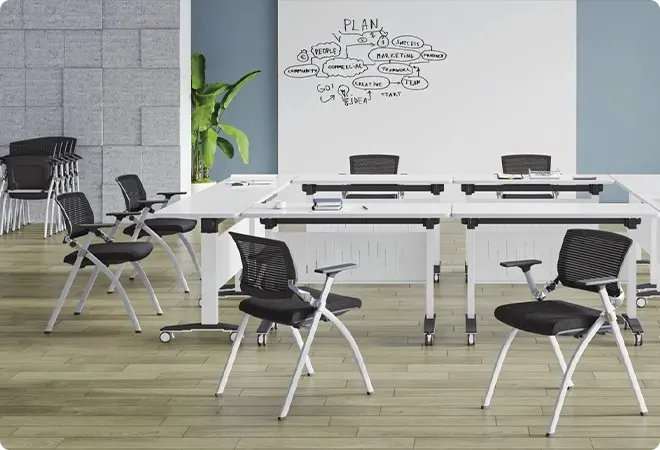
Benefits of Flip Top Training Tables in Training Rooms and Conference Centers
The benefits of flip top training tables include faster room changes, compact storage, mobile layouts, and practical support for frequent commercial use.
BY YOUR SIDE
Our team works with you during every phase of the project.

Tel/Wechat/WhatsApp:
/
Email:
Quick Navigation
Quick Navigation
Stay in Touch
Stay in Touch


