Tel
+86 189 2488 5105

Global public seating service provider
Foshan Winner Furniture Co., Ltd.
Tel
+86 189 2488 5105
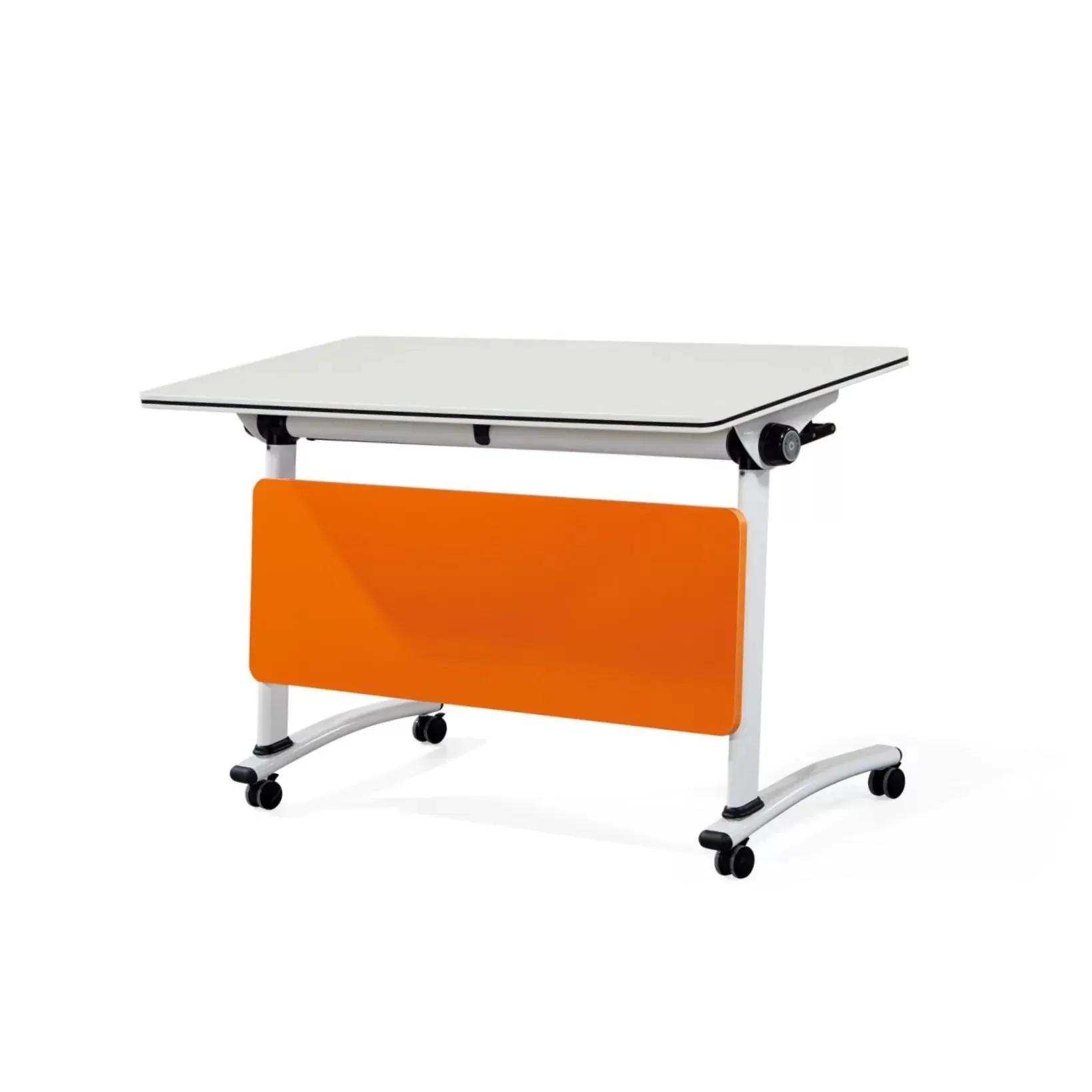
Flip Top Training Tables are mobile tables with hinged tops that rotate vertically for compact storage and horizontal use during instruction, meetings, or group work. I use them as a practical solution when a room must change from rows to collaborative clusters, open floor space, or presentation seating within the same day. Their value depends on more than the tabletop: frame strength, caster quality, locking controls, clearance, storage density, and service support all affect long-term performance.
| Supplier or category option | Table type | Mobility | Storage method | Best use | Indicative price range | Purchasing model |
|---|---|---|---|---|---|---|
| WINNER | Commercial flip-top training table | Locking casters, subject to specification | Nesting or aligned storage | Schools, training rooms, institutional projects | $120–$350 per table before freight | Factory-direct, OEM/ODM, project orders |
| National Business Furniture | Catalog flip-top table category | Casters commonly available | Nesting storage | Offices and corporate training rooms | $250–$650 | Catalog and contract purchasing |
| Gateway Office Furniture | Commercial mobile training table | Caster-based mobility | Nesting or row storage | Offices, conference rooms, classrooms | $180–$500 | Dealer or project purchase |
| Leadcom Seating | Training-room furniture systems | Mobile configurations available | Coordinated room storage | Education, public facilities, large projects | $150–$450 | Manufacturer and project sourcing |
| HON | Commercial training table range | Model-dependent casters | Nesting or folding options | Corporate and administrative interiors | $250–$700 | Dealer and contract channels |
| Marketplace alternatives | Folding or basic mobile tables | Varies widely | Folding, stacking, or limited nesting | Low-frequency use and small offices | $90–$300 | Online retail or marketplace |
Prices are planning ranges rather than quotations. Freight, tabletop material, quantity, finish, power accessories, installation, tariffs, and warranty terms can change the delivered cost substantially.
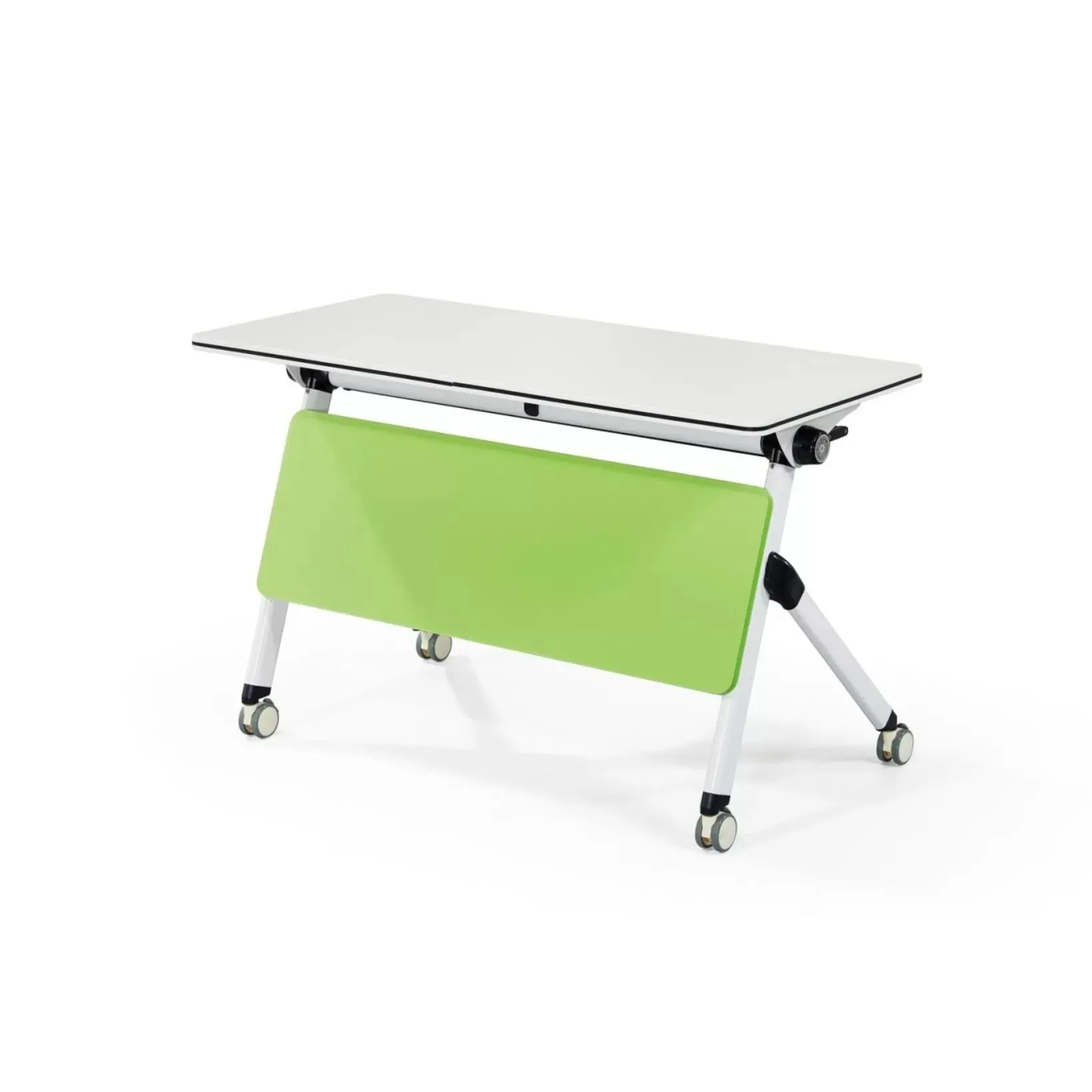
A flip top training table combines a horizontal work surface with a hinged mechanism that allows the tabletop to lift into a vertical position. Most commercial models use a steel or aluminum base, two or more casters, and a release handle or lever that controls the movement. Once the top is upright, several tables can nest together, reducing the floor area required for storage.
I distinguish flip-top tables from ordinary folding tables because the top usually remains attached to the base and the unit is designed for repeated room reconfiguration. Folding tables often require more manual handling and may store as separate flat units. Fixed-top tables provide greater rigidity but do not support compact nesting or rapid changes between classroom, meeting, and open-floor layouts.
For flexible learning spaces, I evaluate a table by how quickly staff can change the room without lifting heavy components or blocking circulation. Mobile flip top training tables support lecture rows, pairs, small groups, U-shaped discussions, testing stations, and open floor configurations. This makes them suitable for classrooms, higher education, corporate training rooms, coworking areas, government facilities, and conference spaces.
The practical benefits are measurable at the room level. A table that nests at approximately one-third of its operating depth can free substantial floor area when twenty or thirty units are stored together, although the exact result depends on the base design. Locking casters reduce unintended movement during writing, while a release mechanism that can be operated from one side reduces setup labor compared with tables that require two-person lifting.
I recommend mobile training tables for flexible classrooms when the room serves more than one teaching format. Teachers can begin with forward-facing rows, move to four-person collaborative pods, and finish with a clear presentation area without bringing in separate furniture. This supports active learning classroom tables, project work, examinations, workshops, and hybrid lessons.
The strongest models balance mobility with stability. Casters should roll without excessive force, include dependable brakes, and be positioned so the table does not twist during movement. A commercial base should also protect chair legs and user feet, while rounded corners and a clean underside reduce collision points in busy classrooms.
Nesting is one of the main reasons buyers choose flip-top tables instead of fixed-top training tables. When the tops rotate vertically, the units can be pushed together in a storage bay, along a perimeter wall, or beneath a designated shelving zone. I still measure the complete nested footprint, including protruding casters, handles, cable baskets, and the turning radius needed to move the stack.
Storage planning should include the route between the room and the storage area. A compact stack is not useful if door widths, thresholds, elevators, or corridor corners prevent safe movement. For small classrooms and multipurpose rooms, I prefer a storage plan that leaves a clear aisle, avoids emergency exits, and keeps the heaviest tables at the most accessible positions.
Common commercial sizes range from compact tables for two users to wider tables for three or four users, but the correct size depends on laptops, writing materials, monitors, and required circulation. Rectangular tops support rows and aligned group tables, while trapezoid or curved shapes can create tighter collaborative layouts. Laminate, melamine, polypropylene, and plywood surfaces each affect weight, cleaning, scratch resistance, and replacement cost.
I would request the actual tabletop thickness, edge treatment, moisture resistance, and impact specification rather than relying on a general durability claim. For schools, stain resistance and rounded edges may matter most. For corporate training rooms, a refined finish and integrated power may justify a higher initial cost if the space is used daily.
The base carries the repeated loads created by movement, writing, leaning, and nesting. Powder-coated steel is common because it provides a predictable commercial structure, while aluminum can reduce transport weight. I check weld points, crossbars, hinge hardware, fastener access, and whether replacement casters or mechanism parts are available.
Casters should match the floor surface and expected load. Hard casters may roll efficiently on carpet but behave differently on tile or polished concrete, while soft tread wheels can reduce noise on hard floors. Each table should have a clear method for locking the wheels and releasing the top, with no exposed pinch points that create avoidable setup risks.
Training tables with integrated power and cable management are useful when learners work with laptops, displays, or charging equipment. I look for cable channels that remain accessible when the top is flipped, power modules that can be replaced without dismantling the frame, and routing that prevents cords from touching the floor. A power module should be specified separately from the furniture because electrical requirements vary by country and facility.
Cable management also affects storage. A table with loose adapters or dangling cords may not nest correctly and can create trip hazards during reconfiguration. Before ordering, I would test one fully equipped sample in both operating and stored positions.
I plan the layout around users, not only table dimensions. A typical classroom needs space for chairs, personal movement, instructor access, wall displays, and accessible routes, so the usable footprint is larger than the tabletop itself. I mark the room with tape, place sample table dimensions on the floor, and test rows, clusters, a U-shape, and an open configuration before approving a large order.
Chair clearance deserves equal attention. Users need enough knee space beneath the top, and table-to-chair clearance must allow people to sit without striking adjacent frames or casters. I also preserve a continuous accessible route and avoid placing nested stacks where they reduce exit access, door swing clearance, or visibility across the room.
For hybrid learning spaces, I assign cable and screen positions before selecting the final table orientation. A room may need a central instructor zone, perimeter power, camera sightlines, and clear access to display walls. Reconfigurable training room furniture works best when storage, technology, seating, and teaching movement are planned as one system.
| Table category | Reconfiguration speed | Storage efficiency | Stability during writing | Best fit | Main trade-off |
|---|---|---|---|---|---|
| Flip-top mobile | Fast | High when nesting | Good with locked casters | Frequent room changes | More hardware than fixed tables |
| Folding table | Moderate | High when folded | Depends on frame | Events and occasional conversion | More lifting and setup effort |
| Nesting fixed-top | Fast to move | Moderate to high | Often very stable | Classrooms with regular layouts | Top does not rotate upright |
| Fixed-top | Low | Low | High | Dedicated rooms | Poor use of shared spaces |
| Height-adjustable | Moderate | Usually low | Good when locked | Ergonomic or sit-stand training | Higher price and greater weight |
I choose flip-top models when storage and frequent reconfiguration are equally important. I choose fixed-top tables when the room has one stable purpose and maximum rigidity matters more than floor recovery. Folding tables may be appropriate for occasional events, but they are less attractive for daily classroom changes if staff must repeatedly lift, unfold, and align each unit.
First, I measure the operating room, the storage zone, and the complete transport route. I record doorway widths, elevator dimensions, floor transitions, turning points, accessible paths, and available power locations. This prevents a common purchasing error: selecting a compact nested table that cannot be moved through the building once loaded with accessories.
Next, I define the reconfiguration frequency. A school changing layouts several times each day should prioritize low-effort mechanisms, quiet casters, replaceable parts, and simple locking controls. A conference room changing layouts once a month may accept a heavier frame or less advanced mechanism if the initial price is lower.
Then I compare the total delivered cost rather than the unit price. My worksheet includes the tabletop, base, casters, power accessories, freight, inside delivery, installation, staff setup time, warranty, routine maintenance, and likely replacement parts. A $220 table that requires frequent caster replacement or specialized service may cost more over five years than a $310 model with accessible parts and a longer structural warranty.
Finally, I request documentation before placing a project order. I ask for dimensional drawings, load information, material details, mechanism instructions, warranty exclusions, packaging dimensions, replacement-part pricing, and sample approval terms. For institutional projects, I also confirm whether the supplier can provide color matching, custom sizing, OEM/ODM support, third-party inspection, and export-ready packaging.
I include WINNER when the purchase involves school furniture, training tables, coordinated seating, or a larger education project requiring factory communication. The company identifies Foshan Winner Furniture Co., Ltd. as a manufacturer serving school, training, auditorium, and public-space furniture categories. Its published capabilities include OEM/ODM support, custom colors and dimensions, project coordination, and factory-direct purchasing.
For buyer due diligence, I would verify the exact flip-top table model, tabletop dimensions, caster specification, load rating, testing documentation, production lead time, and warranty coverage in the quotation. Published company information also describes a 50,000-square-meter facility, more than 20 years of manufacturing experience, 50 robot arms, three quality inspection stages, and support for third-party inspection on larger orders. Those figures are useful for supplier screening, but they should not replace a product sample and contract-level specification.
WINNER may fit schools, government facilities, distributors, and contractors seeking coordinated furniture or custom project quantities. Smaller offices may find a catalog supplier easier for one or two units, while large buyers should compare landed cost, production schedule, payment terms, spare parts, packaging, and after-sales response. I would make the final decision from the complete quotation rather than from supplier scale alone.
The initial table price is only one part of ownership. Delivery distance, lift-gate service, assembly, floor protection, staff labor, storage equipment, damaged-component replacement, and periodic caster maintenance can materially change the five-year cost. I also account for downtime: if a failed hinge takes a table out of service during a training program, the operational cost may exceed the price of the replacement part.
For schools, I prioritize rounded edges, durable surfaces, locking casters, safe hinge access, easy cleaning, and replacement hardware. For corporate training departments, I place more weight on power access, cable routing, finish coordination, quiet movement, and fast room turnover. Coworking spaces and small offices should focus on compact storage, manageable table weight, and a layout that can change without dedicated facilities staff.
For government facilities and event venues, I would specify commercial frames, documented testing, stable brakes, serviceable components, and packaging that protects edges during transport. For multipurpose rooms, the best option is usually a nesting flip-top model with a clear storage plan and enough clearance for accessible circulation. Height-adjustable tables become more appropriate when sit-stand use or specialized ergonomic requirements are central to the brief.
Flip Top Training Tables for Modern Flexible Learning Spaces are most effective when the room must support several activities and staff need to change layouts without storing separate furniture systems. I recommend comparing tabletop size, frame construction, caster locks, nesting depth, mechanism safety, cable management, accessibility, warranty, delivery, and five-year ownership cost before selecting a model.
For daily classroom changes, choose mobile flip top training tables with dependable brakes, low-effort release hardware, replaceable parts, and a storage stack that fits the building route. For occasional events, folding tables may provide a lower initial cost, while fixed-top tables remain suitable for dedicated rooms. Buyers evaluating WINNER or other suppliers should request a complete technical quotation, inspect a sample, and verify the product-specific specification before approving a bulk order.
Latest News
Sep. 28 2026
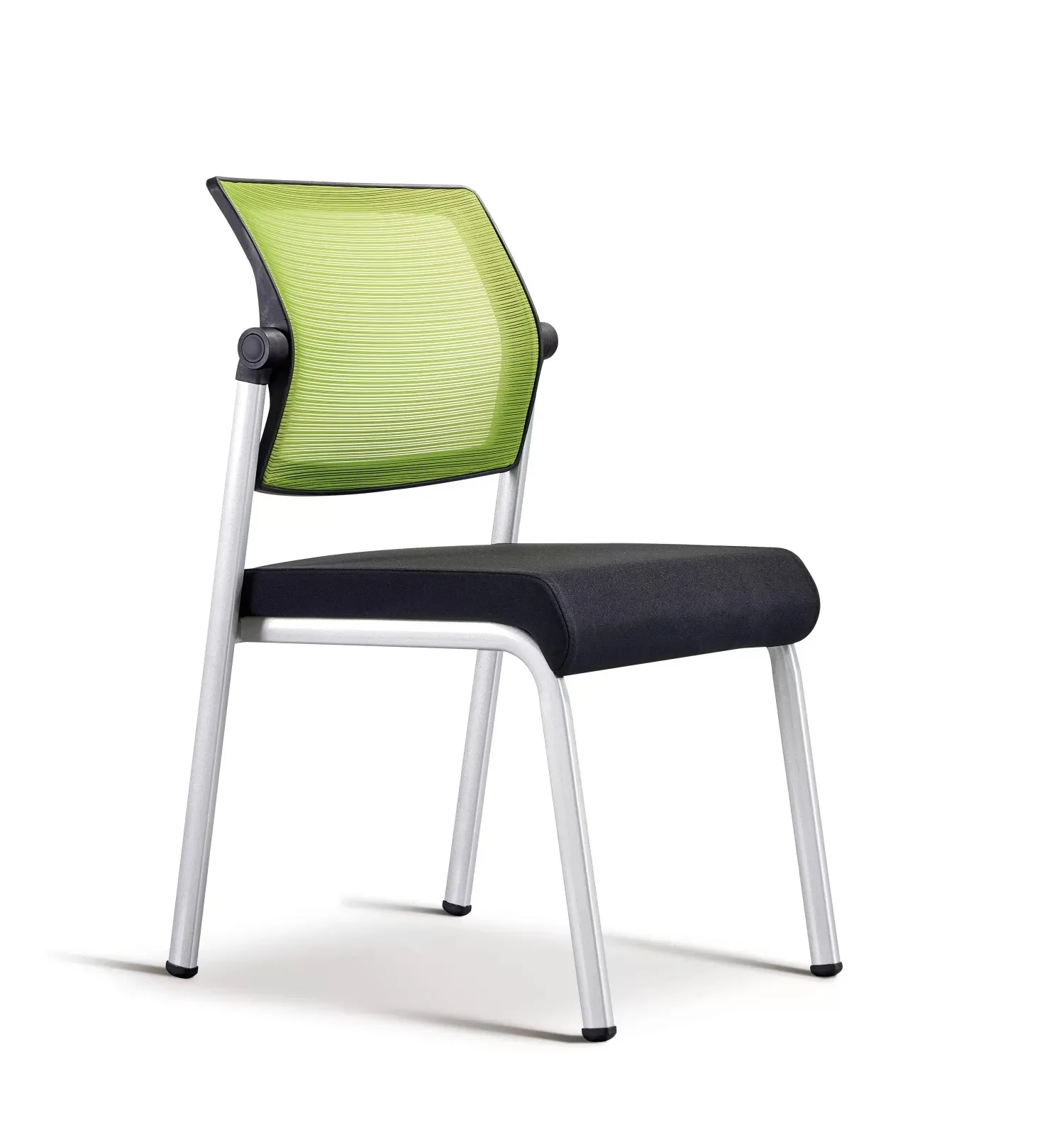
Folding Conference Room Chairs for Space Efficient Meeting Areas
This guide compares folding, stacking, and nesting conference chairs, with space-planning calculations, ergonomic criteria, storage advice, supplier considerations, and layout examples for flexible meeting areas.
Sep. 23 2026
Folding Conference Room Chairs Applications in Training Centers and Event Venues
This guide explains Folding Conference Room Chairs Applications in Training Centers and Event Venues, covering layouts, storage, durability, comfort, transport, and procurement decisions.
Sep. 18 2026
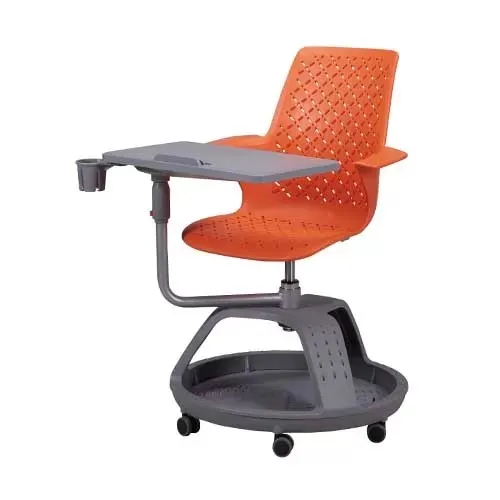
Flip Top Training Tables and Chairs Combination Solutions for Education Spaces
This guide explains how flip top training tables and chairs support flexible education spaces through mobile layouts, compact storage, durable construction, and practical procurement planning.
Sep. 16 2026
Customized Training Chairs for Universities, Companies and Learning Centers
This guide compares customized training chairs for universities, companies and learning centers by ergonomics, mobility, customization, durability, procurement risk and indicative pricing.
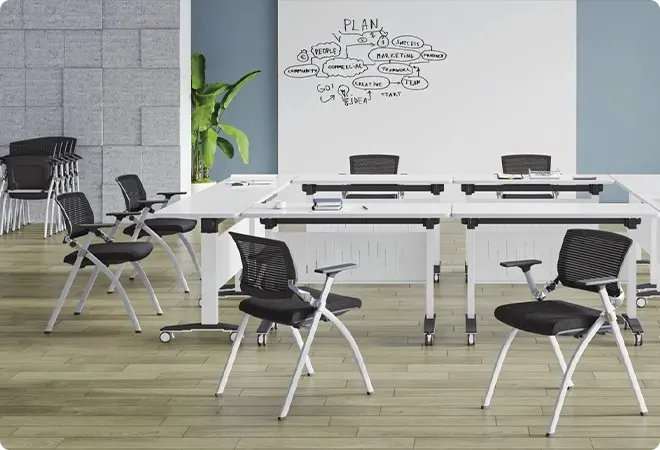
Sep. 11 2026
Benefits of Flip Top Training Tables in Training Rooms and Conference Centers
The benefits of flip top training tables include faster room changes, compact storage, mobile layouts, and practical support for frequent commercial use.
BY YOUR SIDE
Our team works with you during every phase of the project.

Tel/Wechat/WhatsApp:
/
Email:
Quick Navigation
Quick Navigation
Stay in Touch
Stay in Touch


